
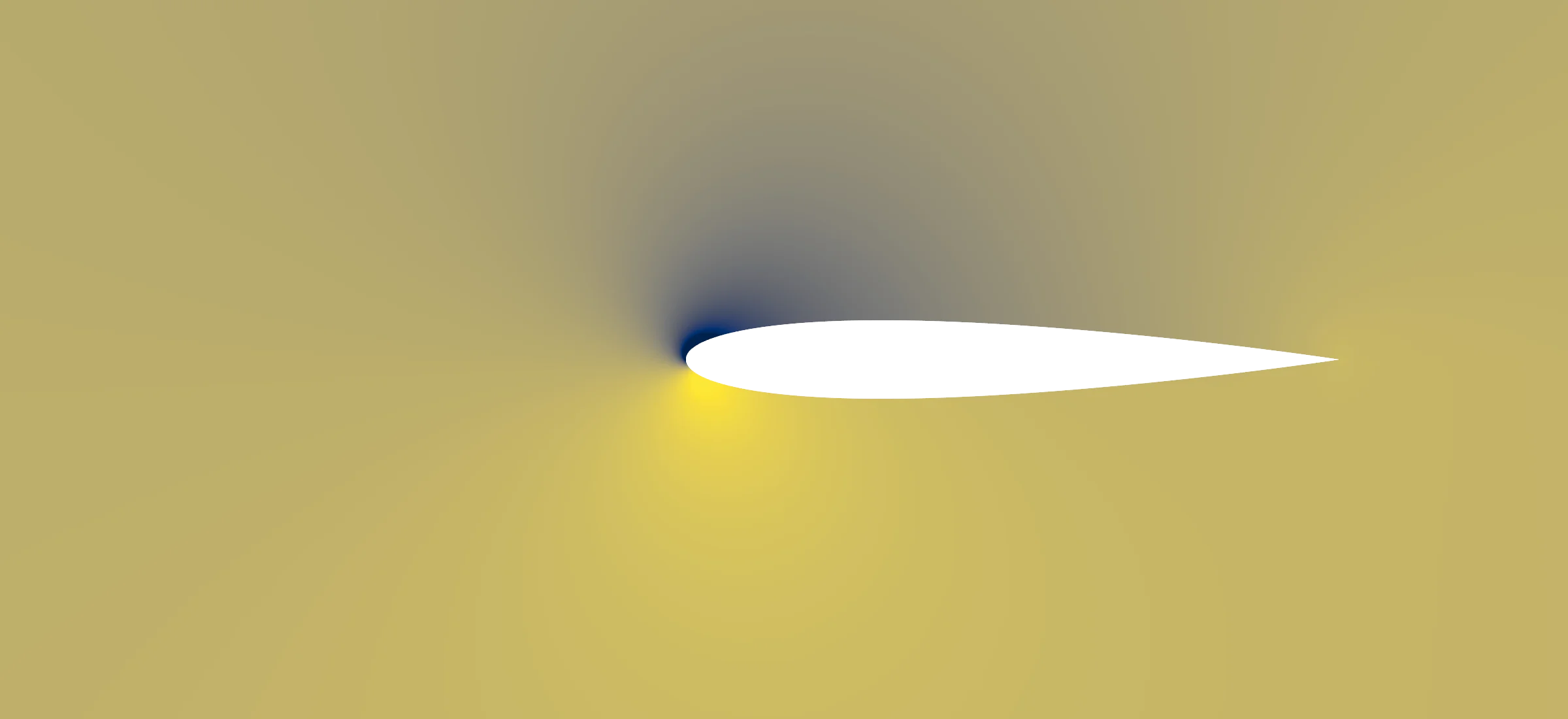
The whole loop, in one window
The same seven steps every CFD job takes. FoamStudio does each one for you, shows the exact command it ran, and leaves you an ordinary OpenFOAM case you can open in a terminal at any point.
- InstallSets up WSL and OpenFOAM, or finds the one you have.
- CasePick a solver; every dictionary is written for you.
- GeometrySTL, OBJ, STEP, Gmsh, Fluent or any NACA section.
- MeshblockMesh or snappyHexMesh, sized from the y+ you want.
- RunSerial or MPI; keeps going if you close the app.
- MonitorResiduals, Cl and Cd live; stops when converged.
- ReportFields, streamlines, probes and an HTML or PDF report.
Meshes built for the wall
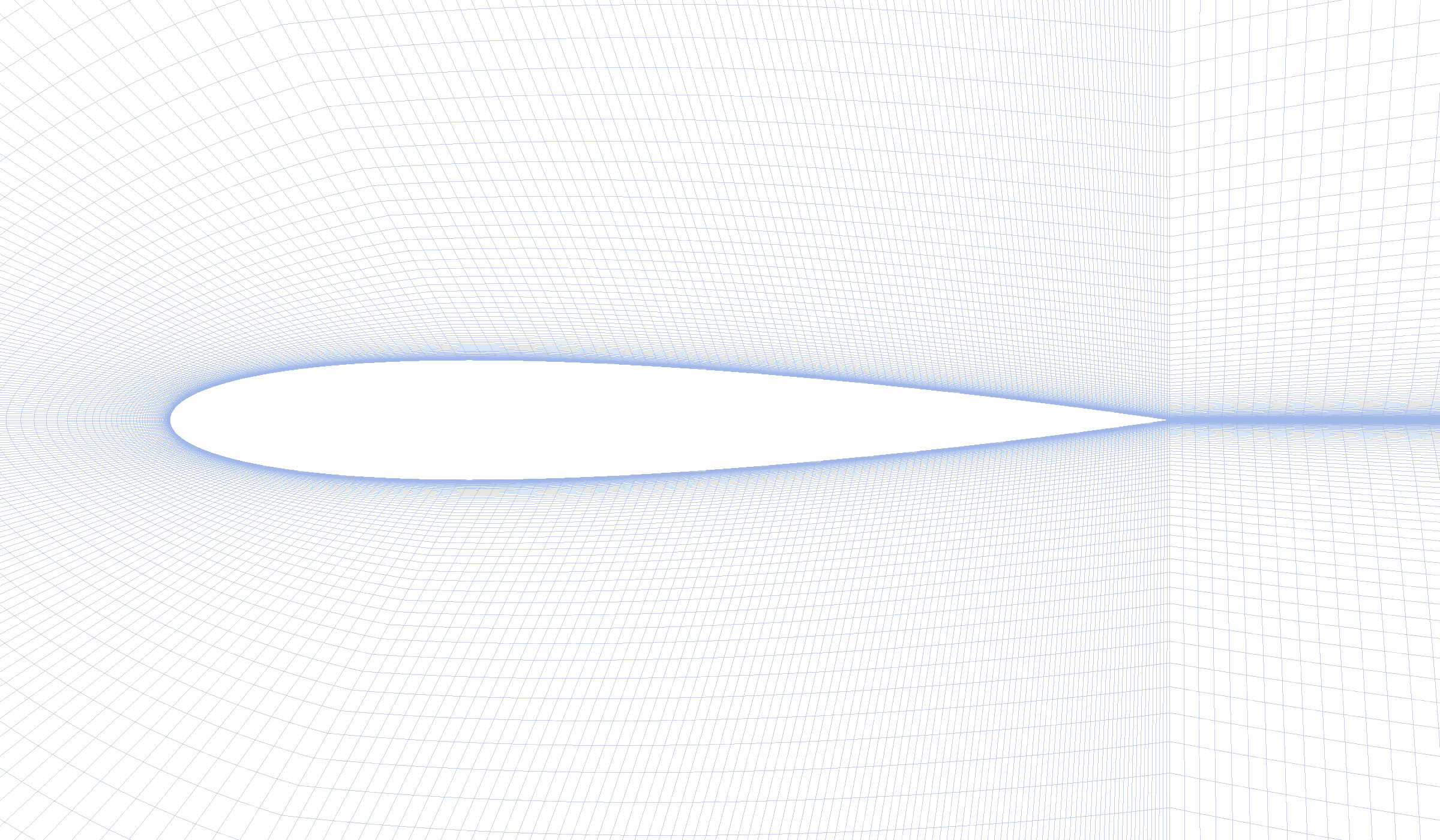
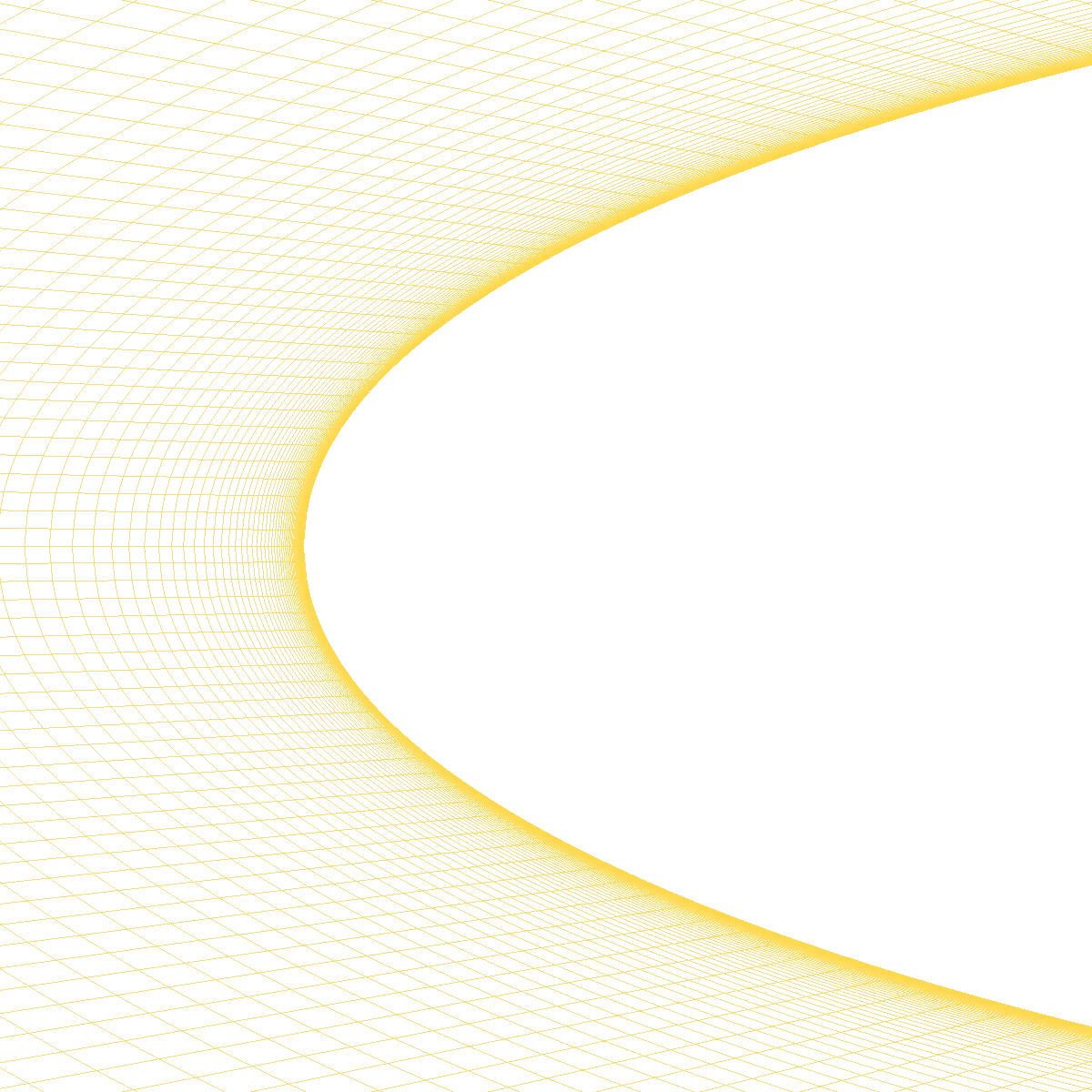
The airfoil template builds a 12-block C-mesh with a wall layer grown along the surface normal. Cells stay square to the wall, where the physics is hardest.
Built to be left running
Real captures from FoamStudio 0.9 on Windows 11, driving OpenFOAM v2412 inside WSL.
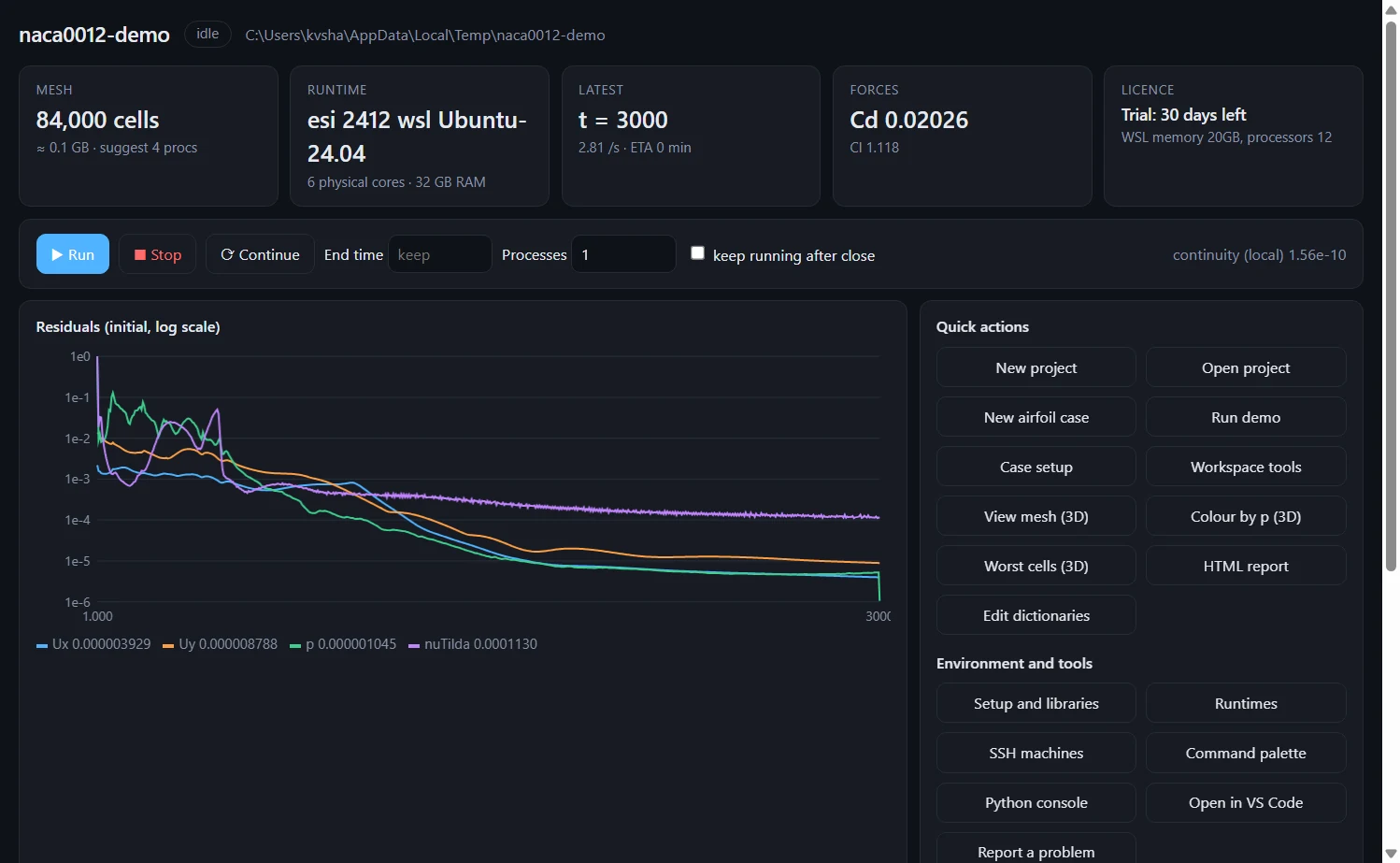
The dashboard after 3,000 iterations: 84,000 cells, ESI v2412 in WSL, Cd 0.02026, residuals falling past 10⁻⁵, and every action one click away.
Convergence you can see
The residual history of the run in the hero image, straight from its solver log. Drag across it to read any iteration.
Raptor 3, start to plume
An engineering estimate of SpaceX's Raptor 3 sea-level nozzle, built on the validated method below: 350 bar, O/F 3.6, area ratio 34.34, gas properties matched to NASA CEA. Axisymmetric, 216,000 cells, run overnight in FoamStudio.
| Quantity | FoamStudio CFD | 1-D theory | CEA or reported |
|---|---|---|---|
| Sea-level thrust | 245.7 tf | 253 tf | 250–280 tf reported |
| Sea-level Isp | 335.5 s | 343.7 s | 349 s CEA, 350 s reported |
| Exit Mach (mass average) | 3.80 | 3.84 | 3.79 CEA |
| Exit pressure | 1.10 bar | 1.10 bar | 1.10 bar CEA |
| Mass flow | 732 kg/s | 736 kg/s | — |
Inputs are public estimates, not SpaceX data, and the exhaust is one gas with a CEA-matched γ. Values at 12 ms. The videos cover the full 12 ms run: the starting vortex ring, shear-layer roll-up and a train of weak shock diamonds behind a Mach disk that is still travelling downstream at 9.5 m. Pressure and density use log colour scales; each background is the colour of ambient air.
What is in it
Grouped by the point in a job where you reach for it.
Checked against the literature
Each case was run through FoamStudio on OpenFOAM v2412. The green band is the published reference; the dot is FoamStudio. The misses are shown too.
Grid convergence, refinement ratio 2
NACA 0012 drag converges monotonically on 22k, 90k and 358k cells (observed order 2.1). Richardson extrapolation gives 0.00847, 4.7% above the NASA TMR value; the gap is the 50-chord far field.
| Quantity | Coarse | Medium | Fine | GCI |
|---|---|---|---|---|
| Cavity, min u | −0.21000 | −0.21305 | −0.21142 | 0.23% |
| Step, x/h | 5.59 | 5.90 | 6.03 | 10.7% |
| Airfoil, Cd | 0.009356 | 0.008674 | 0.008515 | 0.71% |
Solver checks with exact answers
Grid convergence
Error against the exact answer on successively finer meshes. A line steeper than the dotted order-1 slope means the error is falling faster than the mesh is shrinking.
| Group | Series | Meshes | Mesh size h, coarse → fine | Error measured | Coarsest error | Finest error | Observed order | GCI of p2/p1, fine |
|---|
Error is the distance from the exact answer. "Max property error, %" is the largest relative deviation among the checked quantities. "Primary error, % of scale" is the deviation of the one headline quantity (for example Cf or Nu) as a percentage of the exact value. "L1 density error" is the mean absolute density difference over the tube. Mesh size h is the cell size (shock, Prandtl-Meyer, channel, plate cases), 1/√cells (cone and intake cases) or 1/cells (Sod). Observed order is the log-log slope of error against h. GCI is the Roache grid convergence index, an error band on the fine-mesh p2/p1 value.
A thin window over a core you can script
The case generator is the only thing that writes OpenFOAM dictionaries, so the window, the
command line and CI produce byte-identical cases. WSL commands run as LF scripts inside the case, so no
$ ever reaches wsl.exe, and Stop ends the whole Linux process group rather than
only the Windows wrapper.
Ten CI jobs on Windows, macOS and Linux run on every push, including a real solver run and an 85-step scripted walk through the GUI, with pip-audit, an SBOM, CodeQL and an 87% coverage gate on the core.
Install
FoamStudio is commercial software: ₹3,000 per year, up to 3 machines. The installer ships Python and every library; OpenFOAM is set up on first launch.
By buying you agree to the licence terms.
-
Buy a licence
Pay ₹3,000 on the payment page. The installer link and your licence key arrive by email.
-
Choose how OpenFOAM is installed
Automatic sets up Ubuntu 24.04 in WSL and OpenFOAM v2412. Already have one? Pick it from the Runtimes tab, or add an SSH machine.
-
Run the demo
The lid-driven cavity runs in about a minute and proves the whole chain works.
From a terminal
foamstudio --detect-runtimes > rt.json
foamstudio --airfoil 2412 --alpha 4 --re 3e6 --project wing
foamstudio --project wing --runtime rt.json --run-case
foamstudio --project wing --report wing.html